
Factory automation technology is revolutionizing manufacturing, transforming production processes through the integration of sophisticated systems and intelligent machines. This technological shift promises increased efficiency, reduced costs, and enhanced product quality, but also presents challenges related to implementation, workforce adaptation, and cybersecurity. This exploration delves into the various aspects of factory automation, examining its benefits, drawbacks, and future trajectory.
From the fundamental types of automation technologies like robotics and PLC systems to the emerging trends of AI and the Industrial Internet of Things (IIoT), we will investigate the multifaceted nature of this transformative field. We will analyze its impact on production efficiency, labor dynamics, and the overall competitiveness of manufacturing businesses. Furthermore, we will address the crucial aspects of implementation, including planning, risk mitigation, and the importance of skilled personnel.
Types of Factory Automation Technology
Factory automation encompasses a wide range of technologies designed to improve efficiency, productivity, and quality in manufacturing processes. These technologies work together, often integrated into complex systems, to streamline operations and reduce human intervention in repetitive or hazardous tasks. Understanding the different types of automation technology is crucial for businesses seeking to optimize their manufacturing processes.
The core technologies driving factory automation can be broadly categorized into several key areas, each offering unique capabilities and benefits.
Categorization of Factory Automation Technologies
The following table summarizes key factory automation technologies, their applications, and advantages. It’s important to note that these technologies frequently work in concert to achieve comprehensive automation.
| Technology Type | Description | Applications | Advantages |
|---|---|---|---|
| Robotics | Programmable machines capable of performing a variety of tasks, from simple pick-and-place operations to complex assembly processes. | Welding, painting, assembly, material handling, palletizing | Increased speed and precision, improved consistency, reduced labor costs, ability to handle hazardous materials |
| PLC Systems (Programmable Logic Controllers) | Computer-based controllers that automate industrial processes by monitoring input signals and controlling output devices based on programmed logic. | Machine control, process control, safety systems, data acquisition | Reliable, robust, flexible, easily programmable, cost-effective for many applications |
| SCADA Systems (Supervisory Control and Data Acquisition) | Systems that monitor and control industrial processes from a central location, providing real-time data visualization and control capabilities. | Power generation, water treatment, oil and gas pipelines, manufacturing process control | Real-time monitoring and control, centralized data management, improved efficiency and safety, enhanced decision-making |
| MES (Manufacturing Execution Systems) | Software systems that manage and monitor all aspects of the manufacturing process, from planning and scheduling to production tracking and quality control. | Production scheduling, inventory management, quality control, data analysis | Improved production efficiency, reduced waste, better quality control, enhanced traceability, improved data visibility |
Hard Automation versus Soft Automation
Two fundamental approaches to factory automation exist: hard automation and soft automation. They differ significantly in their flexibility, cost, and applications.
Hard Automation involves dedicated, fixed-purpose machinery designed for specific tasks. This approach is highly efficient for high-volume, repetitive processes. Examples include assembly lines designed for a single product or dedicated robotic systems for a specific welding operation. Strengths include high speed and precision. However, weaknesses include inflexibility – retooling for a new product can be expensive and time-consuming.
Changes in production requirements can render hard automation obsolete quickly.
Soft Automation utilizes programmable systems like PLCs, SCADA, and robotics with flexible programming capabilities. This allows for adaptation to changing production needs and product variations. Examples include robotic arms programmed for different tasks or flexible manufacturing systems (FMS) that can handle a variety of products. Strengths include adaptability and flexibility. Weaknesses include higher initial investment in software and programming expertise, potentially leading to higher setup costs compared to hard automation for high-volume, unchanging processes.
Integration Process of Automation Technologies
A flowchart illustrates the typical integration of automation technologies within a factory setting. The process involves careful planning and coordination to ensure seamless communication and data exchange between different systems.
Imagine a flowchart starting with a “Production Planning” box. An arrow leads to a “PLC Programming” box, representing the programming of PLCs to control individual machines. Another arrow branches from “Production Planning” to “SCADA System Configuration,” setting up the system to monitor and control the overall process. Arrows from both “PLC Programming” and “SCADA System Configuration” converge at a “Robotics Integration” box, showing the connection of robots to the PLC and SCADA systems.
Finally, an arrow leads from “Robotics Integration” to a “MES Integration” box, connecting the production data to the overall manufacturing execution system for analysis and reporting. This flow demonstrates the interconnected nature of the various technologies and the importance of their coordinated operation.
Impact of Factory Automation on Production Efficiency
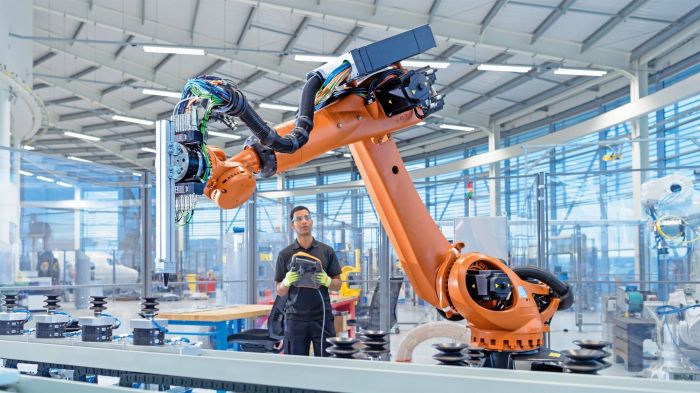
Factory automation significantly impacts production efficiency, leading to substantial improvements across various metrics. The integration of automated systems streamlines processes, reduces errors, and ultimately boosts output, transforming manufacturing operations and impacting the workforce. This section will explore these impacts in detail, examining the effects on production speed, defect rates, labor costs, and return on investment.
Automation technologies contribute to increased production efficiency in several key ways. The speed and precision of automated systems far surpass human capabilities in many manufacturing tasks, leading to faster production cycles and higher overall output. Simultaneously, the consistent nature of automated processes minimizes human error, resulting in fewer defects and improved product quality. This translates directly into cost savings through reduced waste and rework.
Improved Production Speed and Output
Automated systems drastically improve production speed and overall output. The tireless operation of robots and automated machinery allows for continuous production, eliminating downtime associated with human breaks and fatigue. Furthermore, automation enables the implementation of optimized production schedules and just-in-time inventory management, minimizing lead times and maximizing throughput.
- Robotics in assembly lines: Robots can perform repetitive assembly tasks with much greater speed and precision than human workers, significantly increasing the number of units produced per hour.
- Automated guided vehicles (AGVs): AGVs transport materials and goods efficiently throughout the factory floor, eliminating bottlenecks and optimizing material flow, leading to faster production cycles.
- Computer Numerical Control (CNC) machines: CNC machines perform complex machining operations with high precision and speed, increasing output and reducing lead times for manufactured parts.
Reduced Defects and Improved Quality
The precision and consistency of automated systems lead to a significant reduction in defects and an improvement in overall product quality. Human error is a major source of defects in manufacturing, and automation minimizes this risk by performing tasks with unwavering accuracy and following pre-programmed instructions meticulously.
- Automated quality control systems: Automated vision systems and sensors can detect defects in real-time, preventing defective products from progressing further in the production process. This reduces waste and ensures higher quality output.
- Robotics in precision manufacturing: Robots excel in tasks requiring high precision, such as micro-assembly or delicate handling of components, minimizing the risk of damage or defects.
- Automated testing and inspection: Automated testing equipment can perform comprehensive inspections with greater speed and accuracy than manual inspections, ensuring high quality standards are consistently met.
Impact on Labor Costs and Worker Roles
Automation’s impact on labor costs and worker roles is multifaceted. While automation can reduce direct labor costs by replacing human workers in repetitive or dangerous tasks, it also necessitates investments in training and upskilling the workforce to manage and maintain the automated systems. Furthermore, the displacement of some workers is a significant concern requiring proactive strategies for retraining and job creation in related fields.
The introduction of automation may lead to job displacement in certain roles, particularly those involving repetitive or manual tasks. However, it also creates new job opportunities in areas such as system maintenance, programming, and data analysis. Therefore, reskilling and upskilling initiatives are crucial to ensure a smooth transition for the workforce and to capitalize on the benefits of automation.
Return on Investment (ROI) of Automation Technologies
The ROI of automation technologies varies significantly depending on the specific technology, the scale of implementation, and the industry. Factors such as initial investment costs, maintenance expenses, and long-term benefits must be carefully considered when evaluating the financial viability of automation projects. A thorough cost-benefit analysis is essential to determine the long-term profitability of automation initiatives.
For example, implementing a robotic arm for a simple assembly task might have a relatively short payback period due to its lower initial cost and quick integration. Conversely, implementing a fully automated production line may require a substantial upfront investment but can offer significant long-term benefits in terms of increased output, reduced defects, and labor cost savings. Careful planning and a detailed ROI analysis are essential to ensure successful implementation and a positive return on investment.
Implementation Challenges of Factory Automation
Implementing factory automation, while offering significant benefits, presents a range of challenges that require careful consideration and proactive mitigation strategies. Successfully navigating these hurdles is crucial for realizing the full potential of automation and avoiding costly setbacks. A holistic approach, encompassing meticulous planning, robust risk management, and a commitment to continuous improvement, is essential.
The complexities involved in integrating new automated systems into existing infrastructure, coupled with potential security vulnerabilities and the need for a highly skilled workforce, represent significant obstacles. Addressing these challenges proactively is key to ensuring a smooth and successful automation implementation.
Potential Obstacles in Factory Automation Implementation
Several key obstacles can hinder the successful implementation of factory automation projects. Careful planning and proactive mitigation are vital to overcome these challenges and achieve the desired outcomes.
- Integration Complexities: Integrating new automated systems with existing legacy equipment and software can be incredibly complex and time-consuming. This often requires significant modifications to existing infrastructure and processes, potentially leading to delays and unexpected costs.
- Cybersecurity Risks: Automated systems are increasingly vulnerable to cyberattacks, which can disrupt operations, compromise sensitive data, and even cause physical damage. Robust cybersecurity measures are essential to protect against these threats.
- Need for Skilled Personnel: Successfully operating and maintaining automated systems requires a workforce with specialized skills and training. Finding and retaining qualified personnel can be a significant challenge, especially in competitive labor markets.
- High Initial Investment Costs: The upfront investment required for automation can be substantial, including the cost of new equipment, software, integration, and training. This can be a barrier for smaller companies with limited capital.
- Unexpected Downtime: Malfunctions or unexpected downtime in automated systems can significantly impact production efficiency and lead to lost revenue. Effective maintenance and preventative measures are critical to minimize downtime.
Strategies for Mitigating Risks in Automation Implementation
Addressing the risks associated with factory automation requires a multi-faceted approach focusing on both technological and human elements. Proactive measures can significantly reduce the likelihood of encountering major problems during and after implementation.
Data security is paramount. Implementing robust cybersecurity protocols, including firewalls, intrusion detection systems, and regular security audits, is crucial. Employee training on data security best practices and incident response procedures is equally important. This includes training on recognizing phishing attempts and other social engineering tactics. Regular security awareness training should be incorporated into the ongoing employee development plan.
Addressing the skills gap requires a comprehensive approach. This includes investing in employee training programs, partnering with educational institutions to develop specialized curricula, and recruiting talent from relevant fields. Offering competitive compensation and benefits packages is also crucial for attracting and retaining skilled personnel.
Step-by-Step Guide for Factory Automation Project Planning and Execution
A well-structured plan is crucial for successful factory automation implementation. Breaking the project into manageable phases ensures a more controlled and efficient process.
- Needs Assessment: Thoroughly assess the current production processes, identify bottlenecks and inefficiencies, and define specific goals for automation. This involves analyzing data on production output, defect rates, and labor costs to pinpoint areas where automation can deliver the greatest impact. For example, analyzing data might reveal that a particular assembly line is consistently experiencing delays due to manual processes, making it a prime candidate for automation.
- Technology Selection: Research and select appropriate automation technologies based on the needs assessment. This includes evaluating different types of robots, automated guided vehicles (AGVs), and software solutions. Consider factors such as cost, compatibility with existing systems, and scalability.
- System Design and Integration: Design the automated system, ensuring seamless integration with existing infrastructure. This involves creating detailed blueprints and specifications, and carefully planning the physical layout of the automated system within the factory. This stage requires close collaboration between engineers, IT specialists, and factory floor personnel.
- Implementation and Testing: Install and configure the automated system, followed by rigorous testing to ensure functionality and reliability. This involves conducting various tests, including performance testing, safety testing, and integration testing, to identify and rectify any issues before full-scale deployment.
- Training and Deployment: Train employees on how to operate and maintain the automated system. This includes hands-on training, simulations, and ongoing support. A phased deployment approach can minimize disruption to ongoing operations.
- Monitoring and Optimization: Continuously monitor the performance of the automated system and make adjustments as needed. This involves collecting data on key performance indicators (KPIs), such as production output, defect rates, and downtime, and using this data to optimize the system’s efficiency over time. Regular maintenance and updates are also crucial for ensuring long-term reliability.
In conclusion, factory automation technology presents a powerful engine for driving manufacturing innovation and competitiveness. While challenges exist in implementation and adaptation, the potential rewards—in terms of increased productivity, improved quality, and reduced costs—are substantial. By carefully considering the various technologies available, addressing potential obstacles proactively, and fostering a culture of continuous improvement, businesses can leverage factory automation to achieve significant gains and secure a competitive edge in the modern manufacturing landscape.
The future of manufacturing is undoubtedly intertwined with the continued evolution and adoption of these transformative technologies.
FAQ Explained
What is the difference between hard and soft automation?
Hard automation involves fixed-purpose machinery designed for a specific task, offering high speed and precision but lacking flexibility. Soft automation utilizes programmable systems like PLCs and robots, providing greater adaptability but potentially lower speed.
How can cybersecurity risks be mitigated in factory automation?
Implementing robust network security protocols, regular software updates, employee training on cybersecurity best practices, and employing intrusion detection systems are crucial for mitigating cybersecurity risks.
What are the key characteristics of a smart factory?
Smart factories utilize data analytics, AI, and IIoT to optimize production processes, predict maintenance needs, and enable real-time decision-making, leading to increased efficiency and flexibility.
What is the role of AI in factory automation?
AI enables predictive maintenance, quality control automation, process optimization, and advanced robotics capabilities, leading to improved efficiency and reduced downtime.


