
Industrial robotics solutions are rapidly transforming manufacturing and various other industries. This evolution, driven by advancements in artificial intelligence, machine learning, and sensor technology, promises increased efficiency, precision, and safety. From the automotive sector to electronics manufacturing, the impact of robotics is undeniable, prompting exploration into its economic, social, and ethical implications. This overview delves into the diverse types of industrial robots, their applications, and the key technologies driving their progress, providing a comprehensive understanding of this dynamic field.
We will examine the current market landscape, analyzing growth trends and key segments. Furthermore, we’ll explore the integration and deployment processes, highlighting critical safety considerations and providing a practical checklist for successful implementation. Finally, we’ll look towards the future, anticipating emerging technologies and their potential impact on various industries.
Market Overview of Industrial Robotics Solutions
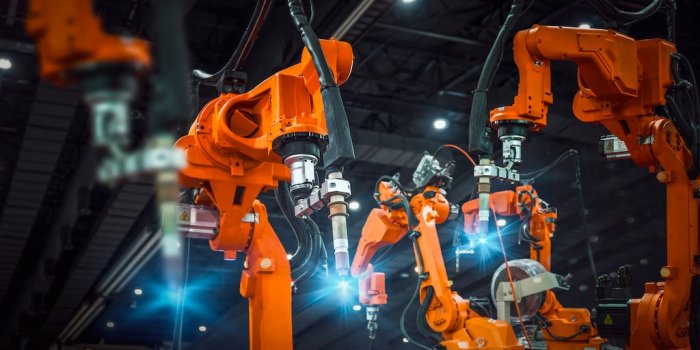
The industrial robotics market is experiencing significant growth, driven by increasing automation needs across various industries and ongoing technological advancements. This expansion is fueled by factors such as rising labor costs, the need for improved efficiency and productivity, and the demand for higher-quality products. The market encompasses a wide range of applications and robot types, each with its own unique growth trajectory and market dynamics.
The global industrial robotics market is currently valued in the tens of billions of dollars and is projected to experience substantial growth over the next decade. This expansion is not uniform across all sectors; some industries are adopting robotics at a faster pace than others. Technological innovations continue to push the boundaries of what’s possible, leading to more sophisticated and versatile robots capable of handling increasingly complex tasks.
Key Market Segments in Industrial Robotics
The industrial robotics market is segmented based on the industries they serve. While the automotive industry has historically been a major driver, other sectors are rapidly catching up. The following table provides a snapshot of key market segments, their current size (approximate figures, as precise data varies across sources), growth rates (projected), and key trends.
| Segment | Market Size (USD Billion, approximate) | Growth Rate (CAGR, approximate %) | Key Trends |
|---|---|---|---|
| Automotive | 15-20 | 5-7 | Increased adoption of collaborative robots (cobots), focus on autonomous mobile robots (AMRs) for material handling, integration of AI for improved decision-making. |
| Electronics | 10-15 | 8-10 | High demand for precision assembly robots, increasing use of vision systems for quality control, growing adoption of smaller, more flexible robots. |
| Metals & Machinery | 5-10 | 6-8 | Automation of welding, cutting, and painting processes, increased use of heavy-duty robots for material handling, integration of digital twins for predictive maintenance. |
| Food & Beverage | 3-5 | 9-11 | Growing demand for hygienic robots for food processing and packaging, increasing adoption of robotic palletizing systems, focus on improving traceability and food safety. |
Recent Technological Advancements in Industrial Robotics
Several technological advancements are significantly impacting the industrial robotics sector, leading to increased efficiency, flexibility, and safety. These advancements are driving the market’s growth and creating new opportunities for innovation.
Examples include the development of collaborative robots (cobots) that can work safely alongside human workers, the integration of artificial intelligence (AI) and machine learning (ML) for improved decision-making and adaptability, and the use of advanced sensors and vision systems for enhanced perception and control. The rise of cloud robotics, allowing for remote monitoring and control of robots, also represents a significant shift.
For instance, companies like FANUC and ABB are actively incorporating AI capabilities into their robot controllers, enabling robots to learn from experience and adapt to changing conditions. Similarly, the increased use of 3D vision systems allows robots to handle more complex and varied tasks, boosting productivity in applications such as picking and placing irregular-shaped objects. The growing prevalence of AMRs in warehouses and factories is another clear indicator of this technological progress, enabling flexible and efficient material handling.
Economic and Social Impacts of Industrial Robotics
The integration of industrial robots into manufacturing processes has profoundly reshaped the economic and social landscapes of numerous industries globally. This section examines the multifaceted impact of this technological shift, exploring its effects on productivity, employment, and the ethical considerations it raises. The widespread adoption of industrial robotics presents both significant opportunities and challenges that require careful consideration.
Increased Manufacturing Productivity and Efficiency
Industrial robots significantly enhance manufacturing productivity and efficiency. Their tireless operation, precision, and speed surpass human capabilities in many repetitive or hazardous tasks. For example, in automotive manufacturing, robots are instrumental in welding, painting, and assembly line operations, leading to faster production cycles and reduced defect rates. A study by the International Federation of Robotics (IFR) indicated that the automotive industry has seen a substantial increase in productivity due to robotic automation, resulting in lower production costs and increased competitiveness.
Furthermore, robots can operate continuously, unlike human workers, maximizing uptime and minimizing downtime caused by breaks or fatigue. This increased efficiency translates directly into higher profits and greater market share for businesses that embrace robotic automation. Companies like Tesla have heavily invested in robotics for their production lines, leading to significant gains in output and cost reductions.
Employment and Job Displacement
The widespread adoption of industrial robots raises concerns about potential job displacement. While robots can automate repetitive and dangerous tasks, freeing human workers for more complex and creative roles, the transition can be challenging for some segments of the workforce. The impact varies across industries and regions, with some sectors experiencing more significant job losses than others. For example, the manufacturing sector has seen a reduction in jobs requiring simple repetitive tasks, while the demand for skilled workers to program, maintain, and manage robotic systems has increased.
This necessitates a focus on reskilling and upskilling initiatives to prepare the workforce for the changing job market. Government policies and industry partnerships are crucial in mitigating the negative impacts of automation and fostering a smoother transition for affected workers. Successful examples include programs that provide training in robotics maintenance and programming, helping displaced workers acquire new skills relevant to the evolving industrial landscape.
Ethical Considerations in Industrial Robotics
The increasing use of robots in industrial settings presents several ethical considerations. One key concern is the potential for increased inequality. The benefits of robotic automation may not be evenly distributed, potentially exacerbating existing economic disparities. Additionally, issues surrounding workplace safety and the potential for robots to malfunction or cause harm need careful consideration and robust safety protocols.
Furthermore, the ethical implications of robots making decisions that impact human lives, such as in autonomous manufacturing systems, require careful examination and the development of appropriate guidelines and regulations. The development and deployment of industrial robots must prioritize human well-being and ensure fairness and transparency in their application. This necessitates a multi-stakeholder approach involving industry leaders, policymakers, and ethicists to establish ethical frameworks that guide the responsible development and implementation of industrial robotics technologies.
Future Trends in Industrial Robotics
The next 5-10 years promise a dramatic reshaping of industrial robotics, driven by converging technological advancements and evolving industry needs. We’re moving beyond the rigid, pre-programmed robots of the past towards more adaptable, intelligent, and collaborative systems integrated seamlessly into complex production environments. This shift will be marked by increased automation, enhanced safety features, and a greater focus on sustainability.The integration of artificial intelligence (AI), machine learning (ML), and advanced sensor technologies will be pivotal in this transformation.
These technologies will enable robots to learn from experience, adapt to changing conditions, and perform tasks requiring higher levels of dexterity and precision than ever before. Furthermore, the growing emphasis on human-robot collaboration will lead to safer and more efficient workspaces.
AI-Powered Adaptive Robotics
AI and ML are poised to revolutionize industrial robotics by enabling robots to learn from data, adapt to unforeseen circumstances, and improve their performance over time. This means robots will be less reliant on pre-programmed instructions and more capable of handling variations in tasks and environments. For example, a robotic arm in a manufacturing plant could learn to adjust its grip based on the shape and size of different parts, minimizing the need for human intervention.
This will lead to increased productivity and reduced error rates. The use of reinforcement learning will allow robots to optimize their actions based on rewards and penalties, leading to more efficient and robust processes. This adaptive capability will be particularly valuable in industries with high levels of variability, such as food processing or logistics.
Advanced Sensor Integration and Enhanced Safety
The incorporation of sophisticated sensors, including vision systems, force sensors, and proximity sensors, will dramatically improve the precision, safety, and adaptability of industrial robots. These sensors will allow robots to perceive their environment in greater detail, enabling them to navigate complex spaces, avoid collisions, and interact safely with human workers. For instance, advanced vision systems can allow robots to identify and classify objects with greater accuracy, facilitating tasks such as picking and placing items in a warehouse environment.
Furthermore, force sensors will enable robots to respond to unexpected forces, preventing damage to equipment or injury to personnel. This heightened awareness of their surroundings and ability to react accordingly will facilitate collaborative robotic applications, improving workplace safety.
Collaborative Robots (Cobots) and Human-Robot Interaction
The development and deployment of collaborative robots (cobots) designed to work safely alongside human workers will accelerate. Cobots are typically smaller, lighter, and more flexible than traditional industrial robots, allowing them to operate in closer proximity to humans without posing a significant safety risk. Advanced safety features, such as force limiting and emergency stop mechanisms, will ensure safe interaction.
Improved human-robot interfaces will also enhance collaboration, allowing humans to easily interact with and program the robots. Imagine a scenario where a human worker and a cobot collaborate on assembling a complex product, with the cobot handling repetitive tasks while the human focuses on more intricate aspects of the assembly process. This combination of human skill and robotic precision will significantly boost productivity and product quality.
A Hypothetical Advanced Robotic System: Revolutionizing the Automotive Industry
Consider a fully automated assembly line in a future automotive plant. This system would integrate multiple advanced robots, each equipped with AI-powered vision systems, force sensors, and advanced dexterity. The robots would collaborate seamlessly to perform a variety of tasks, from welding and painting to installing components and performing quality checks. The system would be capable of adapting to different vehicle models and configurations, requiring minimal reprogramming.
This would significantly reduce production time and costs while improving product quality and consistency. Furthermore, the advanced safety features would ensure a safe working environment for the few human technicians who would oversee the entire system, primarily focusing on maintenance and quality control. The societal impact would include a substantial increase in automotive production efficiency, potentially leading to lower vehicle prices and a reduction in manufacturing-related emissions due to optimized processes.
The integration of industrial robotics offers a transformative path towards enhanced productivity, precision, and safety across diverse industries. While challenges regarding job displacement and ethical considerations remain, the ongoing advancements in AI, machine learning, and sensor technology promise to further refine and expand the capabilities of industrial robots. Understanding the various types of robots, their applications, and the complexities of integration is crucial for businesses seeking to leverage this technology effectively.
The future of industrial robotics is bright, promising innovative solutions and reshaping the industrial landscape in the years to come.
Question Bank
What is the average lifespan of an industrial robot?
The lifespan varies greatly depending on the robot’s type, usage intensity, and maintenance. However, many industrial robots can operate effectively for 10-15 years or even longer with proper maintenance.
How much does it cost to implement industrial robots?
Costs are highly variable and depend on the robot type, complexity of integration, and necessary peripheral equipment. Expect a significant investment, ranging from tens of thousands to millions of dollars, depending on the scale of the project.
What are the major safety concerns related to industrial robots?
Major concerns include accidental collisions, malfunctioning components, and potential hazards associated with high-speed movements and heavy payloads. Proper safety protocols, including guarding, emergency stops, and risk assessments, are crucial.
What are the most common programming languages used for industrial robots?
Common languages include RAPID (ABB), KRL (KUKA), and proprietary languages specific to individual robot manufacturers. Many robots also support integration with higher-level programming languages like Python.


